Personally, I don’t particularly like being monitored and watched by someone else. That was the case back in driving school, and it’s still the case today during safety training. One question that has been on my mind for quite some time is therefore: Can I replace a professional SIV (SIV – Simulation d’Incidents en Vol, meaning ‘simulation of in-flight incidents’) with an SIV that I carry out myself?
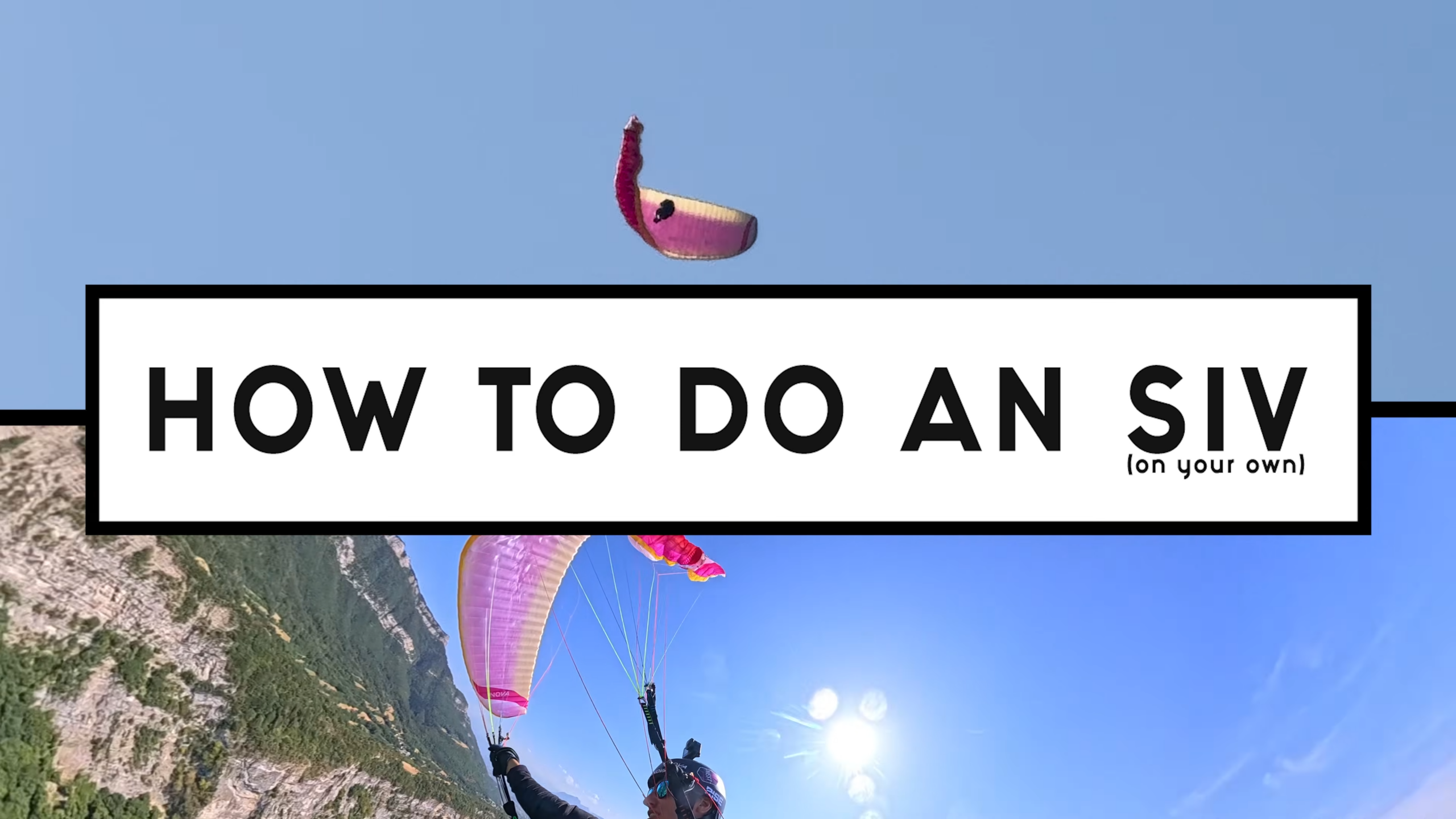
Theo de Blic sees it exactly the same way. He has been posting instructional videos on his YouTube channel for some time now, showing how to carry out various exercises independently, and has recently published a video in which he demonstrates how to carry out an SIV on your own. Safety is paramount, especially when carrying out an SIV on your own, and so he strongly recommends:
- to carry out the SIV using an EN-B at most,
- the rescuer must be available,
- The SIV should be carried out at a location with a significant vertical drop,
- The SIV should be carried out in a safe area, i.e. over water, trees or fields, and
- You should set yourself an altitude limit, at which point you should stop the exercise.
It is also recommended, as an option, to fly with two reserve parachutes and a harness. You should master one exercise thoroughly before moving on to the next, and you shouldn’t put too much pressure on yourself – take your time.
He then demonstrates various practical exercises in the video, including:
- Rattling
- Steep spiral
- Full stall
- Back fly
I took the video as an opportunity to launch a poll in my club’s Signal group. My question was: Do you do SIV on your own initiative? The possible answers were:
- Yes, with exercises that I’ve already mastered.
- Yes, with exercises that are new to me and/or that I haven’t quite got the hang of yet.
- No, absolutely not. It’s far too dangerous to do any exercises without guidance.
Fifteen pilots chose the first option, five chose the second, and two chose the last option. It appears that the vast majority tend to be rather cautious when carrying out SIVs on their own initiative.
I had Chat-GPT summarise the discussion that followed in the Signal group. Many thanks to Georg, Michael, Steffi and Herbert for your contributions to the topic:
Introduction
The discussion focuses on the question of what purpose professionally supervised safety training serves and where the limits of such training lie. Particular attention is paid to the differences between guided SIV, independent training following an SIV, and the general aim of flying more safely in the long term through regular repetition.
A key consensus emerging from the discussion is that safety does not result solely from taking part in an SIV, but rather from a combination of thorough training, professional feedback, practical repetition and an appropriate individual safety margin. Each manoeuvre must be assessed on a case-by-case basis, taking into account its level of risk, the pilot’s own level of training and the prevailing external conditions.
What is a professional SIV expected to achieve?
A commercial SIV is primarily seen as a learning and feedback exercise. The aim is not necessarily to repeat a manoeuvre so many times over the course of a few days that it is mastered to the point of being completely automatic. Rather, the aim is to,
- to learn the correct technique for a manoeuvre,
- to practise responding to disruptions,
- to understand common mistakes and their consequences,
- to learn how to perform purges correctly,
- to gain an insight into one’s own behaviour under high pressure,
- to identify individual weaknesses and
- to receive immediate feedback from an experienced coach.
Typical training exercises include, for example, collapses, wingovers, steep spirals, one-sided stalls and full stalls. Depending on the level of training, more challenging manoeuvres may also be included. The discussion also makes it clear that SIV participants are generally not professional aerobatic pilots. New manoeuvres therefore place considerable demands on mental capacity. For many pilots, even two or three flights requiring intense concentration can already be a significant strain.
SIV is not the same as refresher training
A key point of the discussion is the distinction between learning and consolidation. A professional SIV provides the ideal conditions for understanding a new manoeuvre and performing it correctly for the first time. However, it is less suitable for a large number of repetitions. The reasons for this include:
- limited training time,
- Weather dependence,
- Group size,
- mental strain,
- necessary video analysis,
- theoretical preparation and follow-up, and
- the high level of attention the instructor must pay to each individual flight.
For example, as part of an SIV, a participant can learn to initiate and exit a steep spiral in a controlled manner. However, for these procedures to become second nature, many more repetitions are required. This gives rise to a useful model:
SIV → Learn the concepts and techniques → Receive feedback → Practise independently and in a controlled manner → Develop a routine
An SIV therefore does not necessarily replace independent training at a later stage.
The value of the trainer
A particularly important benefit of a professional SIV is the external perspective. In day-to-day paragliding, once a paraglider pilot has obtained their licence, they often train largely on their own. In other sports, however, regular training with a qualified coach is the norm – for example, in tennis, swimming or skiing. An SIV can therefore be seen as an opportunity to gain a professional and unbiased perspective on one’s own flying. Among other things, the instructor can assess:
- How smoothly is a manoeuvre initiated?
- How does the pilot react to unexpected developments?
- Where do technical faults occur?
- How early does the pilot recognise critical situations?
- How effective is the detox?
- Where do individual ‘blind spots’ lie?
It is precisely these insights that are difficult to gain through independent training. Added to this is the trainer’s experience with different paragliders, their eye for typical errors and their ability to recognise situations at an early stage.
Video analysis as an essential component
Another advantage of professional SIV is systematic video analysis. The video recordings make it possible to review a flight afterwards from a more objective perspective. This allows, for example, the following to be identified:
- Body movements and control movements,
- The timing and amplitude of control pulses,
- Dynamics of the canopy,
- Error during input or output,
- Discrepancies between subjective perception and the actual course of the flight.
This means that the SIV is not limited to flight time alone. Theory, observation and analysis are an essential part of the training programme. A seemingly short training day with just two flights can therefore be very intensive and instructive.
Why two to three flights a day can make sense
During the discussion, the question of whether two or three flights a day are sufficient, given the cost of an SIV, is raised several times. On the one hand, the small number of flights may seem low at first. On the other hand, there are good reasons for this. New manoeuvres require a high level of concentration. As fatigue sets in, the risk of making mistakes increases. The mental strain can be considerable, particularly during challenging manoeuvres. Added to this is the strain on the instructor: they must remain alert during every participant’s flight, assess the situation, intervene via radio if necessary, and subsequently analyse the footage. More flights therefore do not automatically mean greater learning progress. As experience grows and pilots become more accustomed to manoeuvring, their individual resilience may increase. For beginners or pilots learning new manoeuvres, however, two to three focused flights can already be beneficial.
The weather risk associated with a multi-day SIV
Another factor is the high cost of professional SIV training. A training course lasting several days is subject to the same weather conditions as any other paragliding flight. Even if several days have been booked, the weather may mean that only a few flights are possible. A two-day or three-day SIV course may therefore, in the worst-case scenario, result in only a small number of training flights actually being completed. This understandably raises the question of value for money.
At the same time, it is explicitly pointed out in the discussion that this is not intended as a criticism of the providers. Professional SIV providers incur significant costs for organisation, staff, boats, radio, video, insurance and logistics. The limit on the number of flights is also understandable for safety reasons.
Why longer SIVs can be particularly useful for beginners
Several participants report that they found longer training sessions – for example, lasting over a week – particularly valuable, especially during their first SIV experiences. The advantage is that, over several days, a certain routine can develop and the pilot can become accustomed to manoeuvrial flying. With a very short training session, the SIV may end just as the pilot is beginning to get used to the procedures. A longer training session, on the other hand, can enable:
- to develop the theory and fundamentals,
- to carry out a manoeuvre for the first time,
- to analyse errors,
- to try the manoeuvre again,
- to boost one’s own sense of security and confidence, and
- and then carry on working with less support.
However, a longer event does not automatically mean more flight time. The weather and group size remain key factors.
Carry on training immediately after the SIV
A key consensus emerging from the discussion is that, following professional SIV training, independent practice is advisable and, in some cases, essential. This is because it is only through repetition that a technique once learnt becomes an increasingly stable response. However, independent practice should not be equated with professional SIV training. Rather, it is a continuation or consolidation of what has been learnt. Particularly for pilots with a higher level of experience, in the long term there is virtually no way round training outside of an SIV.
It is described as particularly beneficial to carry out a few days’ independent training immediately following an SIV. The advantage is that what you have learnt is still fresh in your mind. If, for example, a manoeuvre is learnt during an SIV and only attempted again several months later, the mental barrier can be significantly greater. Continuing to practise straight away, on the other hand, can help,
- to consolidate the processes,
- To build trust,
- to retain the memory of the correct technique,
- Identifying uncertainties at an early stage and
- to make the transition from supervised to independent training easier.
Some instructors therefore already structure the final SIV flight in such a way that the participant acts as independently as possible, with the instructor only intervening via radio in an emergency. This approach provides a useful intermediate step between supervised and independent training.
Training on your own is mentally demanding
The transition from SIV with an instructor to training alone is described as a significant mental shift. During SIV, the pilot knows that an experienced instructor is observing in the background and can intervene in an emergency. When training alone, this additional safety net is missing. As a result, the pilot has to grapple much more intensively with questions such as:
- What should I do if the manoeuvre doesn’t go to plan?
- Which reaction follows which error?
- When should I abort the manoeuvre?
- How much height do I need?
- Am I even mentally and physically ready for this today?
- Are the current weather conditions suitable?
It is precisely this preparation that can, in turn, provide an important learning experience.
A gradual increase rather than ‘blind’ trial and error
Training on your own does not, by any means, mean trying out a new manoeuvre without preparation. Thorough preparation is considered essential, particularly for challenging manoeuvres:
- theoretical discussion,
- Visualisation of the process,
- Knowledge of the correct technique,
- Preparing for potential errors,
- Running through ‘what-if’ scenarios,
- sufficient height,
- suitable weather conditions,
- suitable equipment,
- a realistic assessment of one’s own abilities.
Ticking a manoeuvre as ‘new to me’ does not therefore necessarily mean that it is impossible to practise it independently. What matters far more is how well prepared the pilot is and how high the risk of error is for that particular manoeuvre.
Not every manoeuvre carries the same level of risk
A key underlying principle of the discussion is that every manoeuvre requires its own safety margin. Some manoeuvres can be tested in a relatively controlled manner and with little risk, whilst others require a significantly greater safety margin. The following are cited as examples:
Can be learnt in a more progressive way:
Wingover: Once you have a good grasp of the technique, you can gradually increase the intensity. At the same time, safety depends heavily on your level of training.
Steep spiral: Once you have learnt how to initiate and exit the manoeuvre, the exercise can be gradually made more challenging. Controlling the rate of descent plays a key role in this.
Significantly higher requirements:
Full stall: Requires a high level of readiness and can become very dynamic if mistakes are made.
SAT: Has a higher potential for unexpected issues and errors and should therefore be properly prepared for and safeguarded against.
Wingover: Depending on the rider’s skill level and the intensity of the manoeuvre, this can also pose a significant risk.
The key point, therefore, is this: the question ‘Can I practise this on my own?’ cannot be answered in general terms for all manoeuvres.
Training on dry land as an additional safety measure
Training on water, wearing a lifejacket and using a boat, is frequently mentioned as a sensible intermediate step. This can offer psychological and safety-related advantages, particularly for more challenging manoeuvres. For example, following a professional SIV course, a pilot may decide to perform their first independent full stalls not over land, but over a suitable body of water. However, the need for thorough preparation remains. Even over water, the risks associated with a manoeuvre do not disappear entirely. Interestingly, it is noted that the first independent attempts can be mentally much more demanding than training with an instructor. The absence of the instructor’s voice forces the pilot to prepare much more thoroughly.
Equipment, mental state, weather and location
When carrying out an independent SIV-style training exercise, several factors are crucial in addition to the manoeuvre itself.
Personal safety equipment plays a key role. For example, the guidelines specify the use of at least two rescue devices for more demanding exercises. The specific equipment must, of course, be suitable for the training exercise, the pilot and the situation in question.
After a long cross-country flight, or when under significant mental strain, you should carefully consider whether you still have sufficient concentration to perform a challenging manoeuvre. ‘Just one quick manoeuvre before landing’ is not necessarily a good idea.
Turbulent or unpredictable conditions can make training considerably more challenging. A manoeuvre that seems easy to control in calm conditions can become much more dynamic under different conditions.
The choice of training location is also crucial. Sufficient altitude, a suitable environment and – in the case of water-based training – a professional rescue service can be key safety factors.
A safety margin rather than a minimum height
A recurring theme in the discussion is the importance of a sufficient safety margin. Not every manoeuvre should be practised at the same altitude and the same distance from the ground. A simpler manoeuvre may, under certain circumstances, be practised closer to the ground than a dynamic manoeuvre with a high potential for error. For new manoeuvres or those not yet mastered with confidence, however, there should be plenty of altitude available. As their experience grows, pilots will be better able to assess the required safety margin. For learning and training situations, however, the following generally applies:
The greater the potential for error, the larger the safety margin should be.
Training as a long-term safety benefit
Despite all the discussion about risks, there is a clear consensus that regular training can, in principle, contribute to safety. A pilot who regularly experiences malfunctions and dynamic situations and practises the correct responses to them may be able to react more quickly and in a more controlled manner in an emergency. However, the quality of the training is crucial. ‘More practice’ does not automatically mean ‘greater safety’. What makes more sense is: more high-quality training, appropriate development, and sufficient safety margins. Overwhelm, fatigue or rushing into demanding manoeuvres too quickly can have the opposite effect.
The SIV as a way of identifying ‘blind spots’
One particularly interesting aspect of the discussion is not to view the SIV solely as a place for learning specific manoeuvres. Rather, it can be understood as a kind of professional mirror reflecting one’s own flying skills. The pilot gains insight into what they have mastered well and where there may be unrecognised weaknesses. These ‘blind spots’ can then be addressed in a targeted and independent manner. This shifts the focus:
Not necessarily:
“After the SIV, I’ll need to have mastered all the manoeuvres.”
Rather:
“After the SIV, I have a clearer idea of where I stand, what I need to improve and how I can continue training safely.”
SIV as part of an ongoing training culture
Ultimately, the discussion raises the fundamental question of why paragliders often receive relatively little structured training once they have obtained their licence. In many other sports, it is normal to work regularly with coaches, even as an advanced athlete. In paragliding, by contrast, development is often largely self-directed. An ideal training structure could therefore consist of several levels:
- Basic training → Learning the basics of flying
- Professional safety training → Malfunctions, manoeuvres, techniques and feedback
- Independent study → Revision and consolidation
- Mentors, clubs or training groups → mutual feedback and sharing of experiences
- Regular professional training sessions → fresh inspiration and a chance to assess your own skills
The SIV should therefore not be regarded as a one-off event, but as part of a long-term continuing professional development programme.
The quality of SIV training today
The discussion also highlights that the quality of professional safety training has been significantly standardised thanks to the certifications and standards set by the DHV, ÖAeC and SHV. Whilst there used to be significant differences in quality between different providers, the accredited schools now all operate to a consistently high standard. For beginners, this means much greater certainty when choosing a professional training course. Where several providers have comparable professional qualifications, other factors may therefore become decisive:
- personal liking,
- Communication style,
- didactic approach,
- Experience with specific paragliders,
- Training philosophy,
- Group size,
- Video analysis,
- organisational framework.
Conclusion
The discussion paints a nuanced picture of the relationship between professional SIV and independent safety training. Above all, a professional SIV is a tool for learning, analysis and feedback. It enables participants to familiarise themselves with new manoeuvres under controlled conditions, to develop the correct technique, to identify mistakes and to receive immediate feedback from an experienced instructor.
However, it is not primarily designed to automate every manoeuvre through a large number of repetitions. For this purpose, independent training following appropriate preparation is advisable and necessary in the long term. At the same time, independent training should under no circumstances be seen as a substitute for professional guidance. Particularly when it comes to demanding manoeuvres with a high risk of error or unexpected events, a trainer provides an important additional safety net.
The most sensible approach therefore seems to be a combination of the following: professional SIV for learning and to assess one’s current level → immediate independent revision → gradual progression → regular professional assessment.
The individual situation is always the decisive factor here. Manoeuvres, weather, location, equipment, physical and mental condition, and experience must all be considered together. The central idea can therefore be summed up in a simple formula: training does not automatically make you safer – but good, systematic and appropriately supervised training does. Or to put it another way: the aim of an SIV should not be to tick off as many manoeuvres as possible as quickly as possible. The greater long-term value lies in gaining a better understanding of one’s own abilities, limits and weaknesses, and then working on them in a targeted manner.