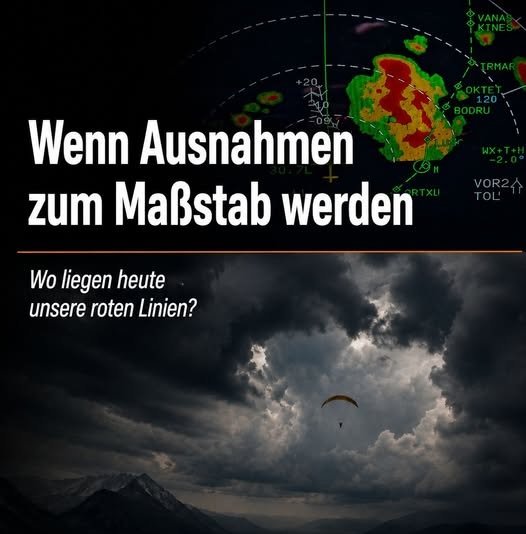
That’s the question Marcel Dürr asks on Facebook. His post specifically focuses on amateur pilots, not competitive pilots, who generally know what risks they’re taking.
Marcel Dürr’s Facebook post, copied in its original form (translated from german):
“Are we currently shifting our security standards?
The many serious paragliding accidents in recent weeks have given me pause for thought. The following reflections are expressly not about any individual accidents. Every accident has its own story and its own causes. Rather, I am concerned with a different question: are we, as a community, currently and unwittingly shifting our standards for what we still consider to be a normal level of risk? An honest discussion about our risk culture seems to me to be urgently needed – and I would be particularly interested to hear your views on this.
I’ve been paragliding for 27 years – and flying commercial aircraft for just as long. Comparing these two worlds never ceases to fascinate me. In commercial aviation, the limits on how to deal with thunderstorms have hardly changed in recent decades, despite enormous technical advances. Commercial aircraft still maintain large safety margins. And for good reason: the risk hasn’t changed. The limits have remained the same.
In paragliding, on the other hand, I get the impression that what we regard as an acceptable level of risk has gradually shifted. In cross-country flying, new records are often only possible if weather windows are exploited more and more thoroughly. More tailwind, more acceleration, fewer safety margins. At some point, the decisive factor becomes, above all, a greater willingness to take risks. A similar effect can be seen in hike-and-fly competitions. Those who are prepared to push closer to the limits of the weather than others can gain a competitive edge. Of course, these are top-class pilots. That is explicitly not my point. What concerns me far more is the effect on the rest of the community. Anyone who repeatedly sees such flights succeed can easily draw the wrong conclusion: ‘Apparently, you can do it.’ Yet a successful flight merely proves that it went well on that one occasion – not that the decision was safe or sensible.
Today, live tracking, Instagram and YouTube further amplify this effect. Above all, we see the spectacular flights that go well. By contrast, hardly anyone sees the many pilots who deliberately turn back, land early or don’t even take off in the first place. This easily creates the impression that borderline conditions are now the norm – even though they never were. Top performances don’t just break records. They can also shift our standards. I sometimes deliberately stay on the ground because I consider the conditions to be borderline. At the same time, on precisely such days, I see countless gliders in the air via live tracking. That makes me wonder: have our gliders really become that much more capable and safer – or have our safety standards shifted above all else? After all, the atmosphere still follows the same laws of physics as it did 27 years ago.
The airline industry counters a creeping shift in boundaries with fixed standard procedures and clear limits. This safety net is virtually non-existent in paragliding. This makes honesty with oneself, personal limits and the discipline to stick to them all the more important. Perhaps that is why we should spend less time discussing who was at fault after an accident, and instead take a more critical look at our own decisions.
Am I taking off because the conditions really are within my personal limits – or because it’s Sunday and I finally have the time? Have my personal standards perhaps shifted without me realising? Am I guided by my own safety criteria – or by the flights I see on live tracking or on Instagram? Sometimes it takes more flying prowess to stay on the ground than to take off. Perhaps we’d all make a few fewer flights then. But perhaps that would sometimes be the best flying decision of the day. Because the question isn’t what’s just about possible today. The question is, what price are we prepared to pay for it?”
Comments on the post
I have summarised and anonymised the comments on Marcel’s post using AI:
The comments reveal widespread agreement with the central argument that risk-taking in paragliding is on the rise and that this could contribute to an increase in accidents. Many see the article as an important catalyst for reflection and call for an open discussion on safety culture and risk management.
The most common causes cited are:
- Social media, live tracking and online competitions: the constant visibility of spectacular flights, records and rankings creates pressure to compare oneself with others and motivates many pilots to push their own limits. One particular concern is that successful flights are often perceived as safe, even though they may simply have ended well by chance.
- Psychological factors: Many report overconfidence, peer pressure, the influence of other pilots and a tendency to want to achieve ever more following successes. It is emphasised on several occasions that comparing oneself with others can impair one’s own judgement.
- Weather and season: The exceptionally hot high-pressure systems, long days with thermals, stronger valley winds and turbulent air conditions are cited as key risk factors. At the same time, the long flying days and high flight density statistically lead to more accidents.
- Modern equipment: More high-performance paragliders enable impressive flights, but also require considerably greater skill. Higher speeds mean significantly greater dynamics in the event of a problem, and therefore higher risks.
- Training and risk management skills: Several comments call for more structured further training following basic training, particularly in decision-making, risk management and meteorology. The systematic review of near-miss incidents is also considered beneficial.
Many describe their personal experiences:
- Some people say that they consciously choose not to fly on a regular basis if the circumstances or their own gut feeling aren’t right.
- Others have given up paragliding altogether because they felt they no longer had enough time, practice or confidence in their own safety.
- Several of them talk about their own accidents or serious mistakes from which they have learnt and, as a result, have set clear personal boundaries.
A recurring thought is that not taking a flight can often be the better decision. Experience is frequently associated with the ability to consciously choose not to take a flight.
Other influencing factors are also discussed, such as:
- Climate change, with increasingly challenging flying conditions.
- Marketing and competitions that promote the motto ‘faster, further, higher’.
- The lack of experience among many occasional flyers or pilots with little flying experience.
- The desire to learn more about the causes of accidents and near-misses, rather than just seeing spectacular successes.
Some commentators are putting the debate into perspective, pointing out that the number of accidents may not have risen significantly in relation to the number of pilots, or that top pilots do not necessarily have a higher accident rate than less experienced pilots.
Overall, the prevailing view is that safety should take precedence over performance. Many emphasise that every pilot must know their own limits, assess them realistically and act on their own responsibility. Greater self-reflection, better training and a more open safety culture are seen as key approaches to reducing risks.