Why happiness isn’t a strategy; the Kruger–Dunning effect; obsessed with the idea of understanding the weather; Toftum Bjerge, Denmark: magical paragliding
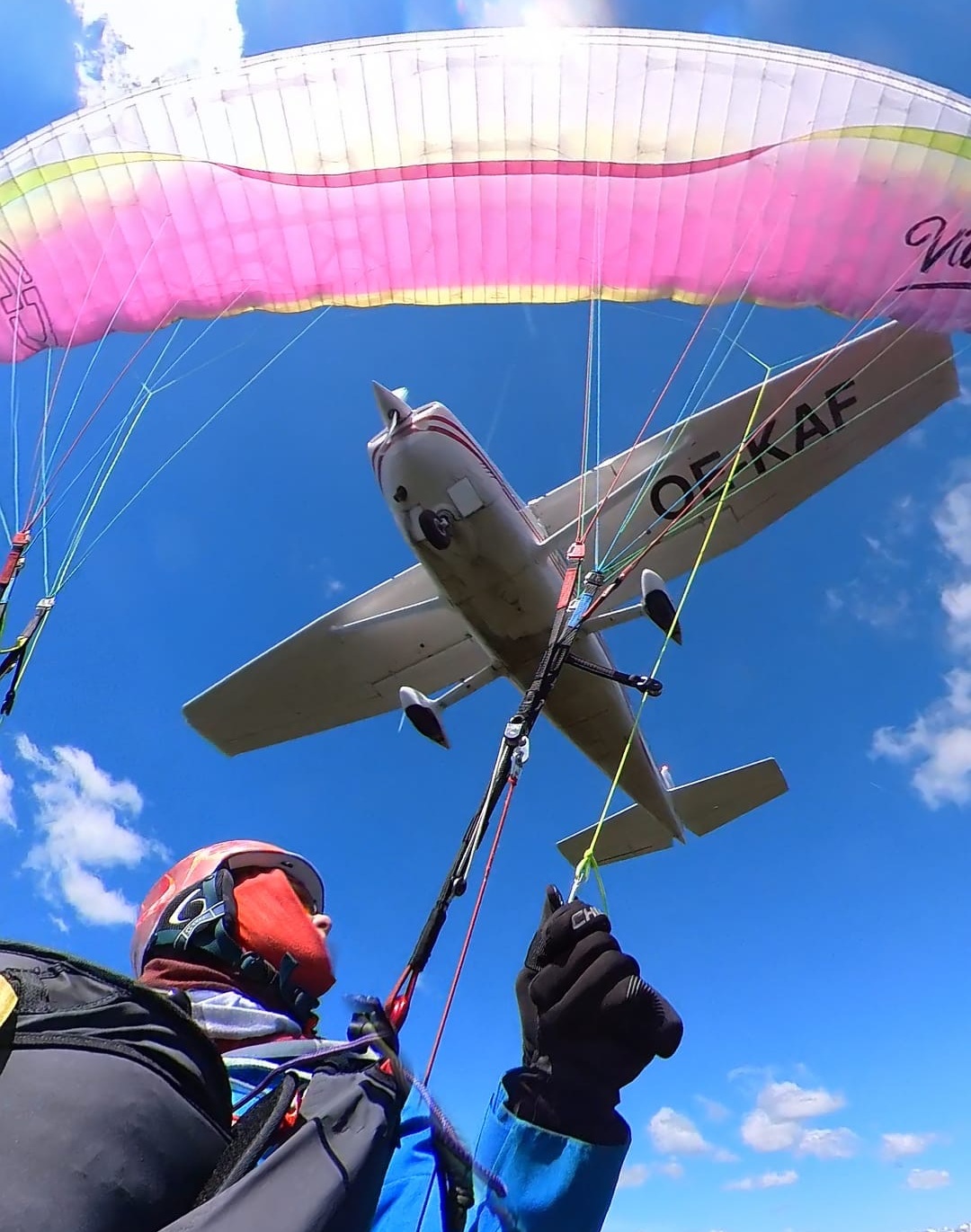
In its latest newsletter, FLARM explains why it makes sense to fly with FLARM (translated from the original English):
Why luck is not a strategy
A recent example clearly illustrates the role that safety devices like FLARM play in the airspace: a few weeks ago, a video made headlines, demonstrating just how fine the line between a lucky escape and disaster can be in the sky. On May 23, 2026, a Cessna 172 on a sightseeing flight near Zell am See, Salzburg, struck the canopy of a paraglider pilot. Both the paraglider pilot and the Cessna pilot were incredibly fortunate: she managed to deploy her reserve parachute in time and land safely, while he brought his aircraft down without damage—and both escaped uninjured, save for a few bruises.
We subsequently spoke with the paraglider pilot. Her conclusion: one should not rely on luck in the sky; instead, reliable technology is needed to provide early warnings of other air traffic. That is precisely what FLARM stands for.
I recently published a video in which the so-called Kruger–Dunning effect was portrayed as particularly dangerous in paragliding. Science wouldn’t be science if previously established findings weren’t called into question from time to time. The following text is a brief ChatGPT summary of the detailed article on www.scinexx.de (in German) on the subject:
A new study by the University of Bath and the London School of Economics calls the classic Dunning-Kruger effect into question. Whilst it was previously assumed that it was primarily less competent people who overestimate their abilities, a re-analysis using improved statistical methods paints a different picture: the earlier interpretation may have been largely based on statistical distortions. In fact, it is actually highly competent individuals who tend to overestimate their abilities to a greater extent.
The researchers attribute this, amongst other things, to random variations in test results and the statistical effect known as ‘regression to the mean’. Whilst a lack of self-awareness in individual people may still lead to overestimation, it does not fully explain the original Dunning–Kruger effect.
Furthermore, the authors propose an evolutionary explanation: a certain degree of overconfidence could be advantageous, as it enhances one’s reputation and social status. At the same time, human loss aversion ensures that, despite their self-confidence, most people do not take excessive risks.
As paragliders, we are particularly dependent on the weather. It therefore makes sense to understand the cultural background and history behind this. There is an interesting article on this subject on Welt.de:‘Obsessed with the idea of understanding the weather’ (in German), which I have summarised with the help of ChatGPT:
The text describes the development of our understanding of the weather and shows how closely meteorology and literature have been intertwined over the centuries. Literary scholar Michael Gamper examines how our understanding of the weather is reflected in scientific findings and literary works.
For a long time, weather forecasting was based on observations, farmers’ sayings and, in some cases, false assumptions, such as the belief in the influence of the planets. It was only with the development of precise measuring instruments such as thermometers, barometers and hygrometers, and the systematic collection of data in the 18th century, that meteorology emerged as a science.
Writers such as Johann Wolfgang von Goethe and Adalbert Stifter explored the weather in depth in their works. Goethe even took part in meteorological measurements and devised the cloud classification system that is still in use today. Whilst literature initially sought to understand and explain the weather, its role changed as meteorology advanced: the weather increasingly became a poetic symbol and a subject for artistic expression (‘meteopoetics’).
Thanks to weather stations, telegraphy, weather balloons and modern computers, weather forecasts have steadily improved. Today, the focus is shifting from the weather to the climate. According to Gamper, ‘climate fiction’ is already emerging as a new literary genre that explores the consequences of climate change.
In conclusion, the text emphasises that conversations about the weather are by no means merely trivial small talk. In light of the increasing frequency of extreme weather events, they are once again taking on existential significance, as information about heatwaves, heavy rain or storms can help to warn and protect people in good time.
Gunter Kiphard has been making videos and posting them on his YouTube channel for 19 years now. Among other things, he covers information on flying sites, as in his latest video, which reports on the soaring opportunities on the west coast of Denmark. It’s also well worth having a browse through his archive. Some of the videos are almost cinema-quality.