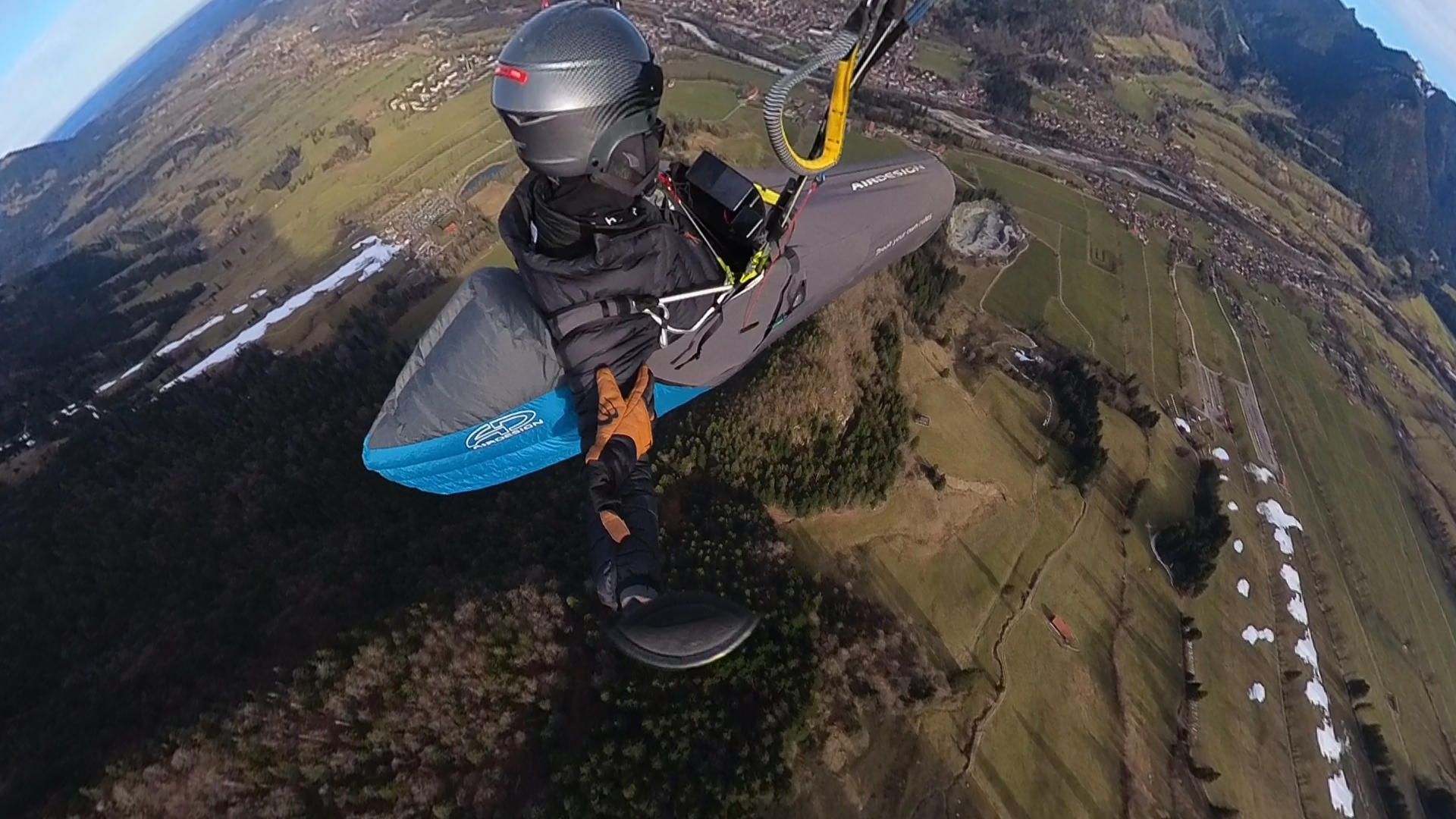
As I announced at the beginning of November, I would like to test harnesses at regular intervals. The first harness in this series was the lightweight harness The Sock from AirDesign.
Please note the notes and restrictions on the tests. The harness was made available to me for testing by the Hochries flying school. I gained the knowledge for this report in calm winter air with a light southerly wind and very weak thermals on a day with four short flights on the Brauneck. For better classification: I weigh 80 kg and am 1.76 m tall. I had the size M available for the test.
Construction
The Sock is a lightweight harness, the weight in size M is 2.75 kg. It is advertised as an all-rounder on the AirDesign website, but due to its lightweight construction, it is certainly intended primarily for hike and fly and bivouac adventures.
As far as I can tell, the quality seems to be good. Appropriate reinforcements are sewn in at points with higher loads, such as the carabiner attachments. The zips are smooth-running, and those on the side pocket are particularly smooth-running. The relatively short rump is made of ripstop fabric and the basket and leg bag are made of elastane fabric. From my point of view, it is an advantage that, despite the lightweight construction, soft links have been dispensed with in favour of carabiners for the main suspension.
The harness has an air protector that goes all the way up to the back area. This is a big plus compared to protectors that only cover the back in order to fulfil the standard. The seat is pre-shaped by the protector, which ensures a comfortable fit (photo 1). This comes pretty close to harnesses with a fixed seat shell. The leg bag is not removable and there is no seat board. The height of the suspension from the seat board to the carabiner loops is approx. 41 cm.
The parachute is installed in the front container, which of course ensures accessibility, even if you should fall into the cloth. The connecting line to the parachute is routed round the outside on the right and ends in the shoulder area (photo 2). One advantage after a parachute throw: you arrive standing on the ground, compared to a parachute that is hooked into the main carabiner. I have not tested parachute installation and removal, but it should not be a particular challenge. The space available for the parachute seems to me to be very limited. In any case, the parachute should be folded as compactly as possible, otherwise the cockpit board will be deformed, as was the case with my tester. The angle of the cockpit is optimally orientated towards the pilot (photo 6).
There is little storage space available for things that need to be available in flight, the side pockets have a depth of 23 cm. Why can’t the side pockets be longer? There would be room on the leg bag. There is a small mesh pocket underneath the cockpit, in my opinion too little storage space for the flight. In contrast, there is plenty of other storage space. The storage compartments consist of the tail pocket (photo 3), the bow pocket, the net pocket (under the cockpit) and the pocket in front of the protector (photo 2). This should provide enough space for a bivouac adventure.
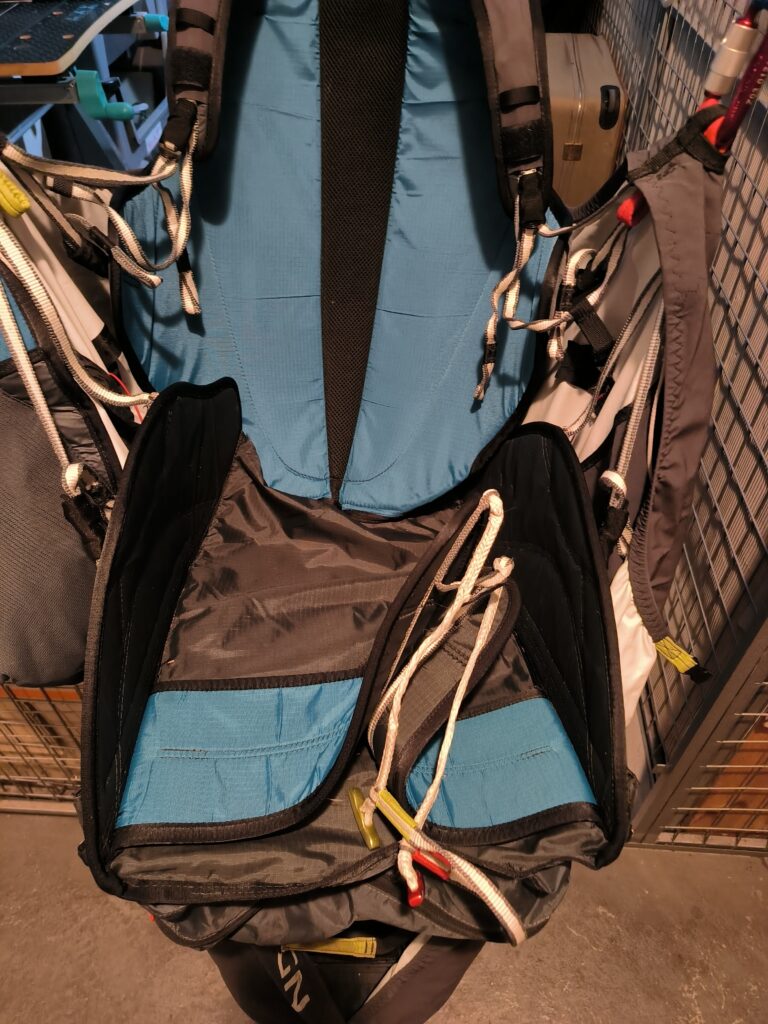
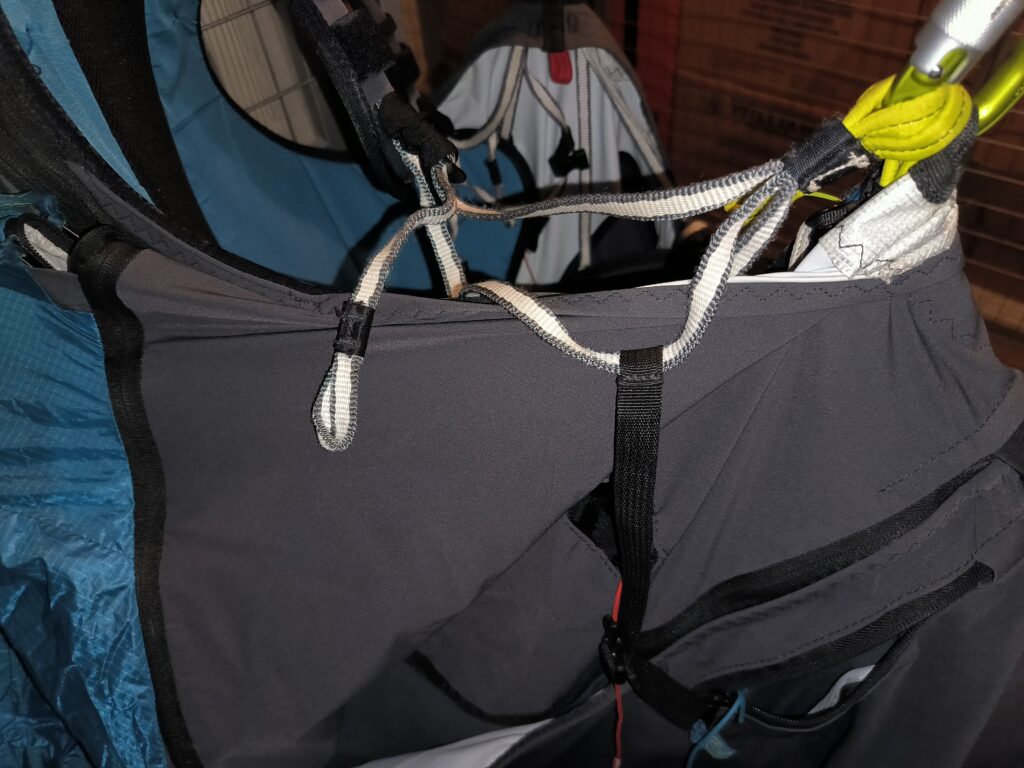
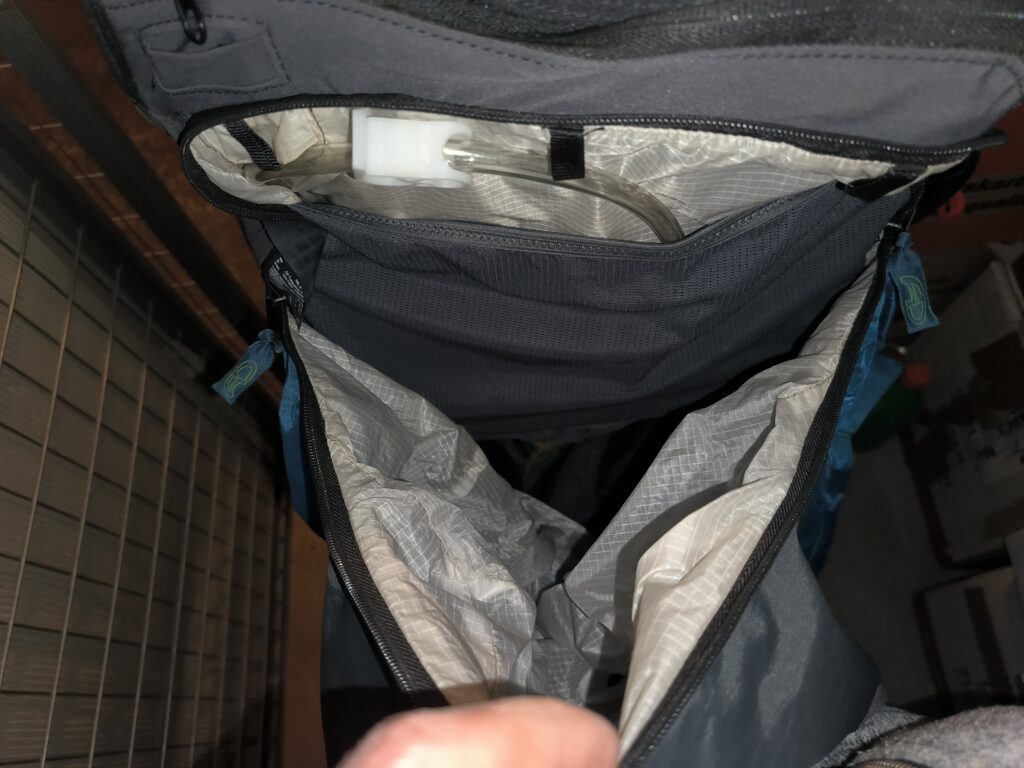
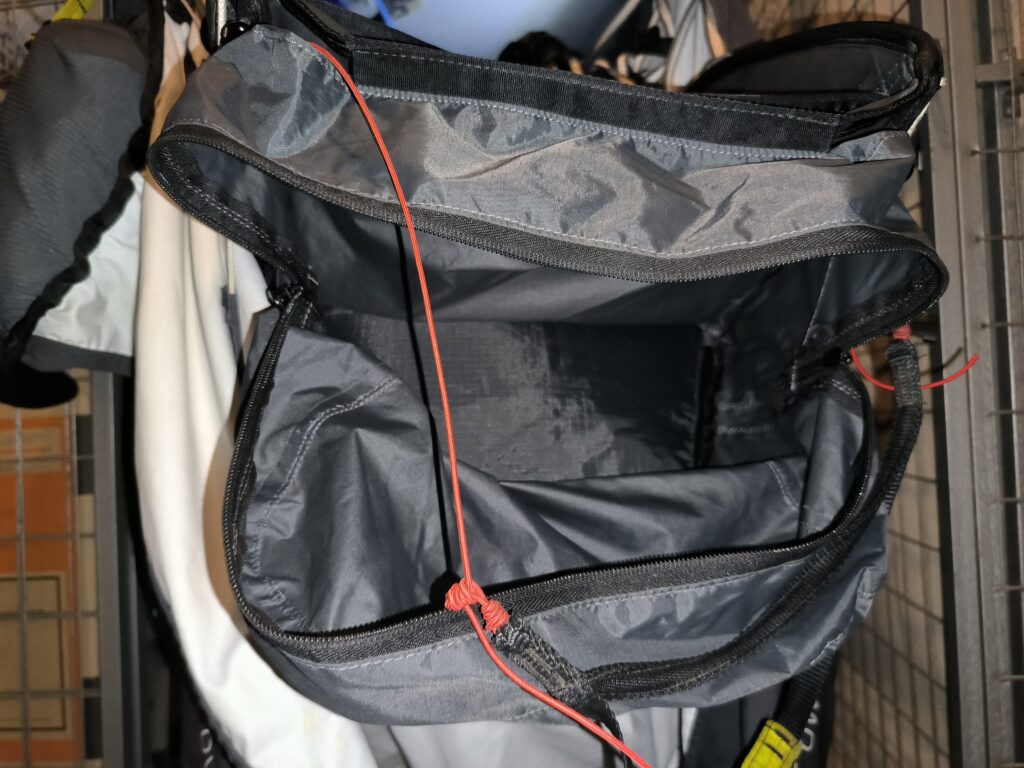
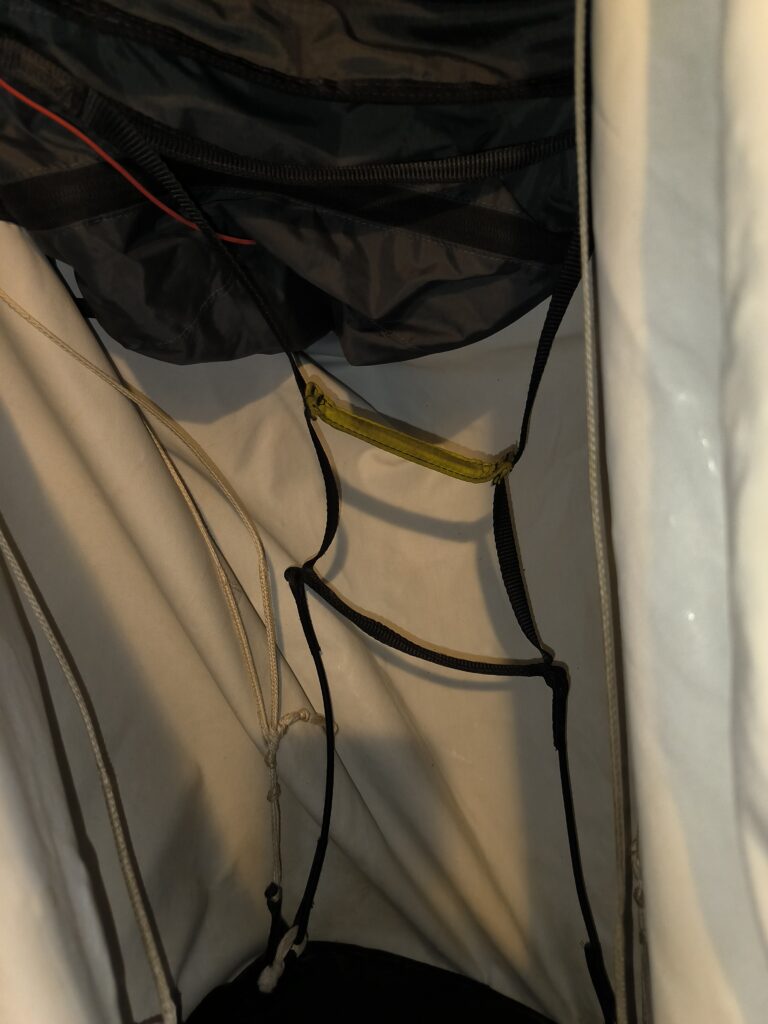
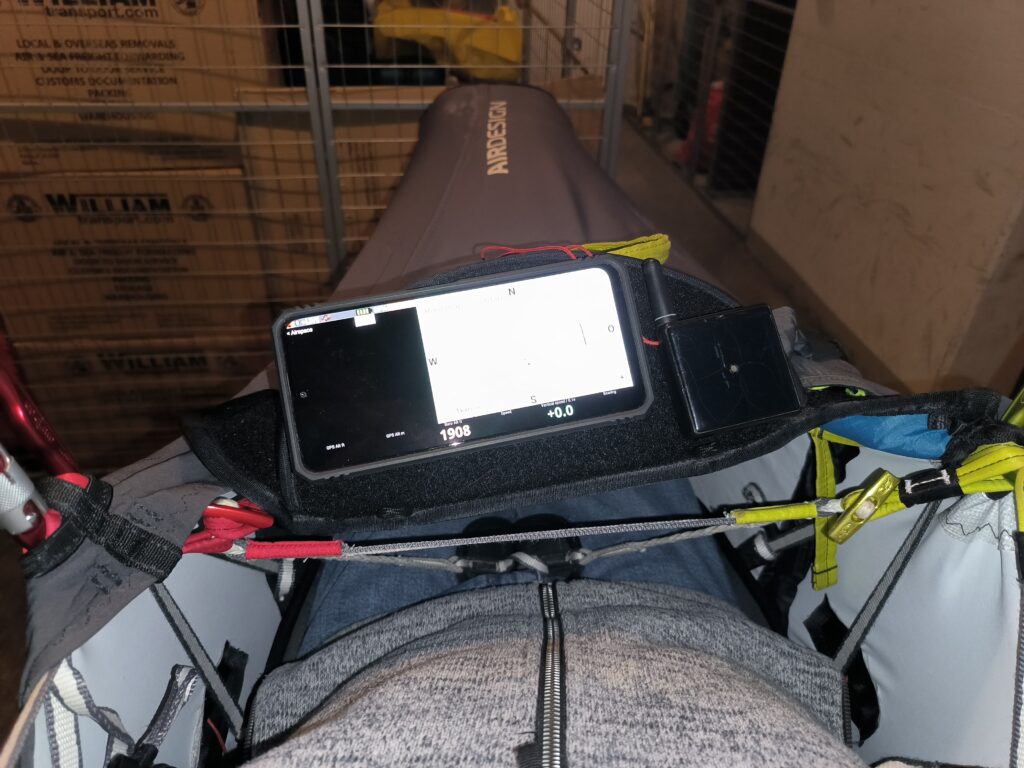
»The picture is crooked«, Loriot would say, in my case it is the cockpit, which is slightly crooked and could not be corrected. The side where the cockpit is hooked in is pulled down by the leg strap (photo 6). Unfortunately, only the centre step of the speed bar is stiff. The bottom and top steps of the three-stage speed bar are simply loops (photo 5).
Settings
I am 1.76 metres tall and didn’t have to change any settings. As this is a tester, I don’t know if my predecessor made any changes to the settings. The anchor stitch for adjusting the leg bag length was attached to the centre knot, the perfect setting for my height (photo 3). Thanks to the pre-shaped fit, I immediately felt comfortable when I sat down on the simulator. The Sock lives up to its name.
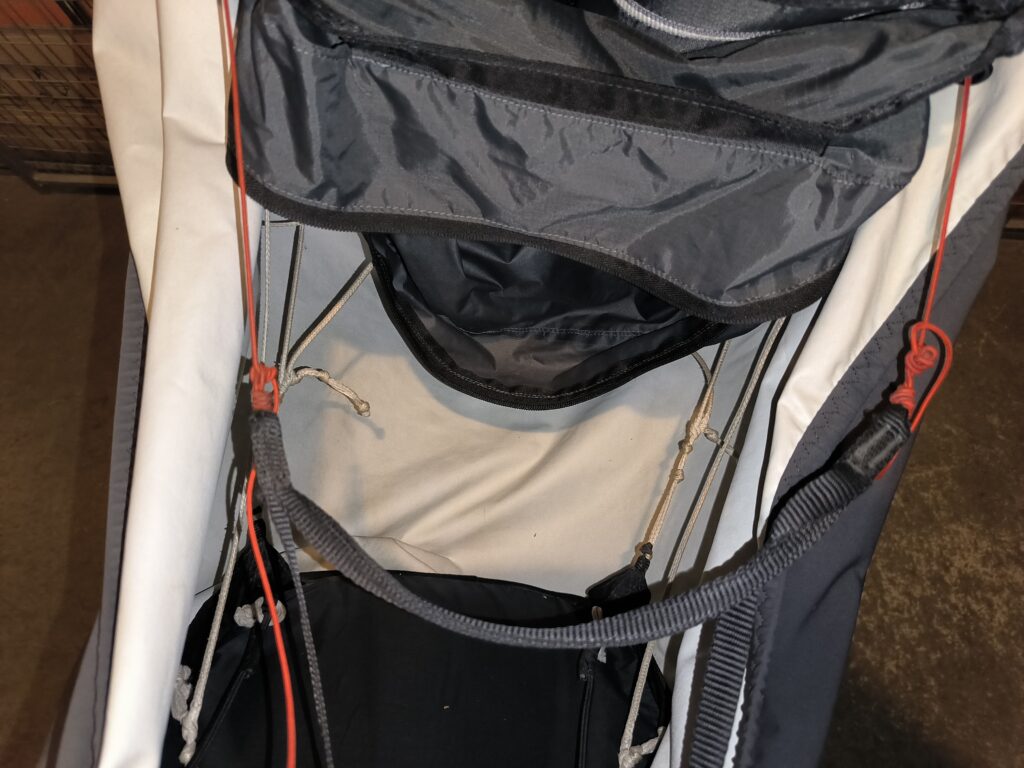
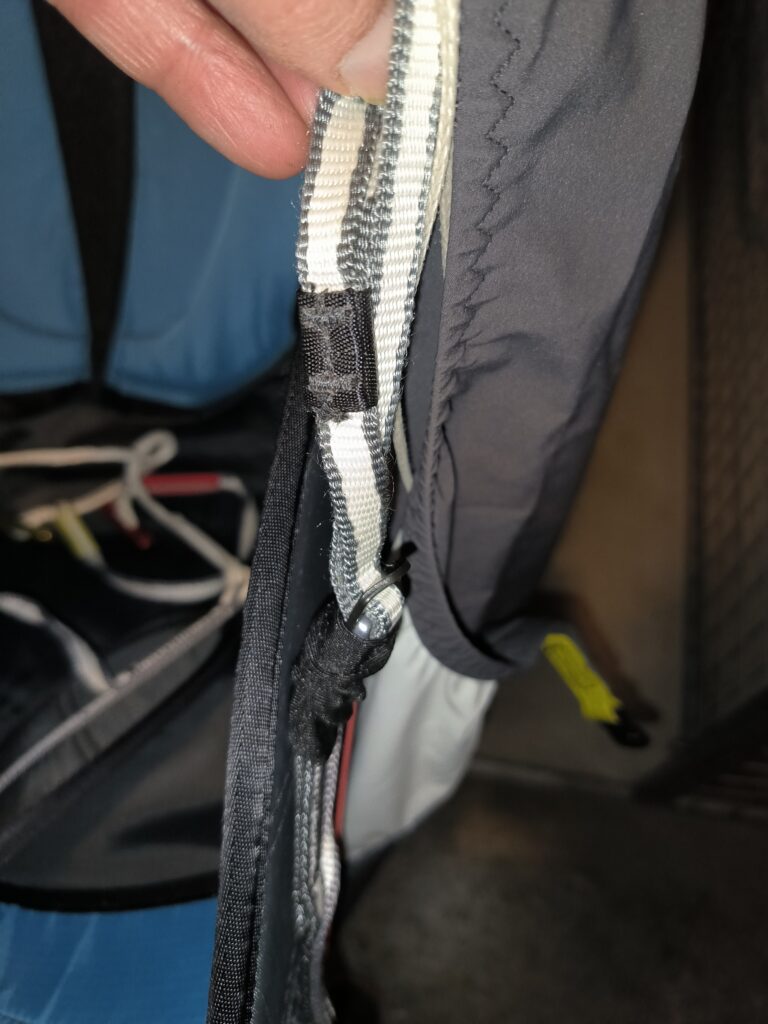
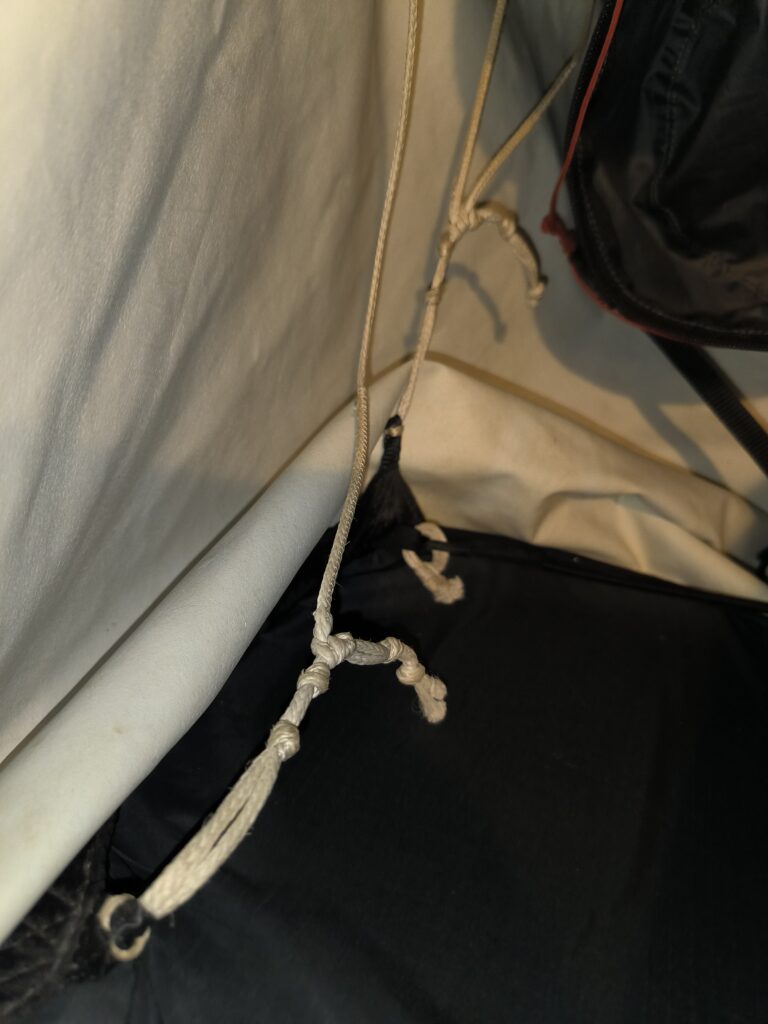
The speed bar steps cannot be adjusted individually. The speed bar is adjusted in the foot area so that it cannot be adjusted in flight (photo 1). The positions of the back support and shoulder straps can be adjusted using buckles (photo 2). The buckles are also accessible in flight.
The distance between the carabiners is fixed by the size, in my case 44 cm for the M size. It is therefore not possible to readjust the distance in flight in order to react to different external conditions, e.g. to reduce the distance in strong thermals.
Create and start
Due to the large protector, you have to let air into the airbag several times to inflate the protector despite the large airbag, even in windy conditions at the launch site. As there is no seat board, the protector should be inflated tightly so that a minimum of weight control is possible. Make sure that the clamp on the hose of the protector is well closed, otherwise the air can easily escape again.
The harness is very easy to put on. The colour-coded T-bones must be inserted into the corresponding loops. Only the insertion of the red T-bone into the cockpit loop could be a little difficult when wearing gloves. But all in all, the cockpit is very easy to put on and it is almost impossible to make a mistake. As the cockpit is closed with the second T-bone over the first T-bone of the leg strap, it should not happen that you forget to close the leg straps (anti-forget system). Don’t forget to attach the elasticated rope for hauling in the leg bag (not mentioned in the instructions).
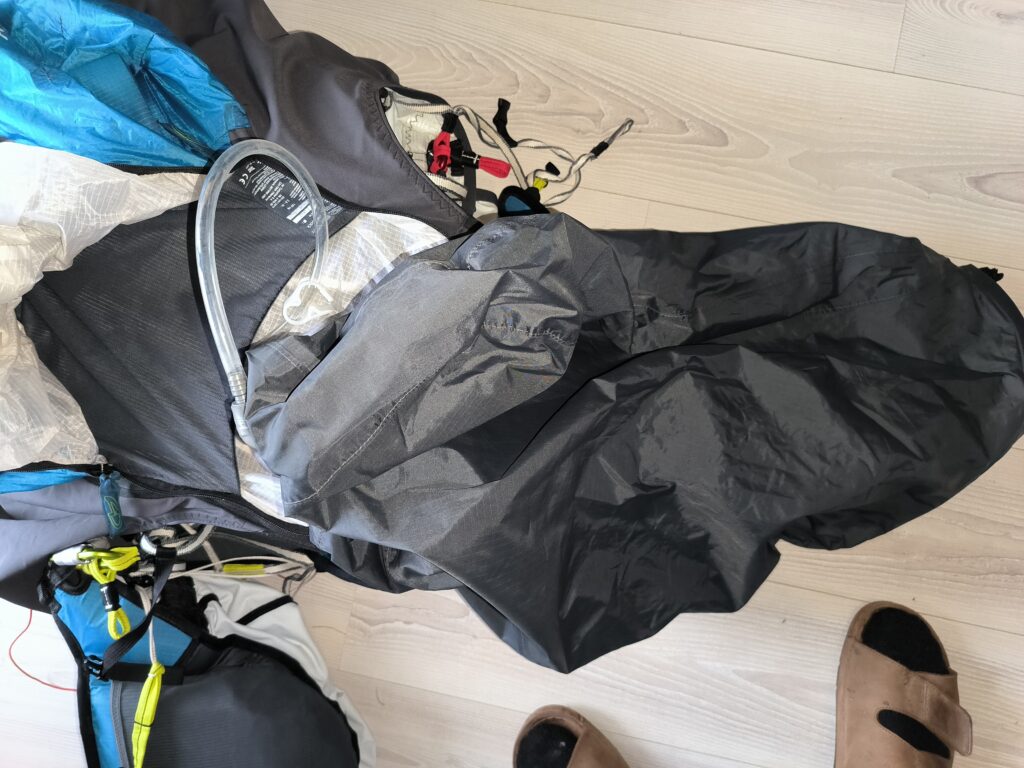
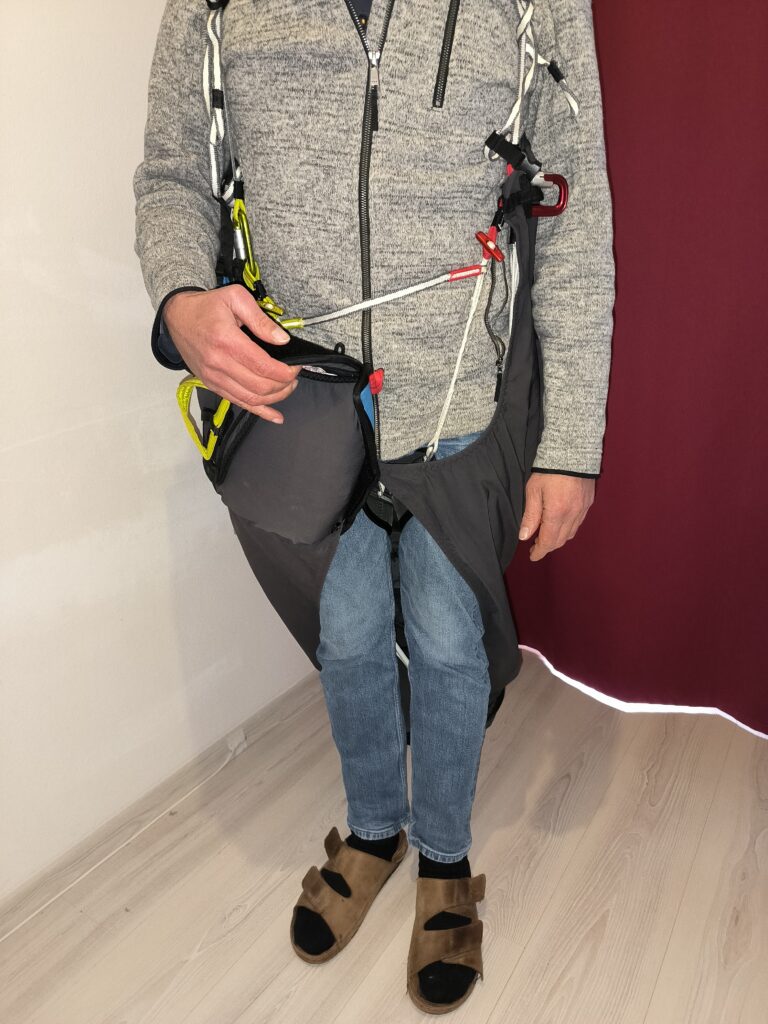
The leg straps have wide contact surfaces, which is very comfortable, especially for male pilots. I had no problems at all during the take-off run and when getting into the harness.
The relatively short rump is inflated relatively quickly after take-off.
Flying, landing and packing
Only the centre accelerator stage is stiff, which makes it quite difficult for me to pick up. The logic behind this is incomprehensible to me. Why not make all the steps stiff? Without a seat board and even with its inflated protector, it was impossible for me to fly a turn just by leaning into the turns.

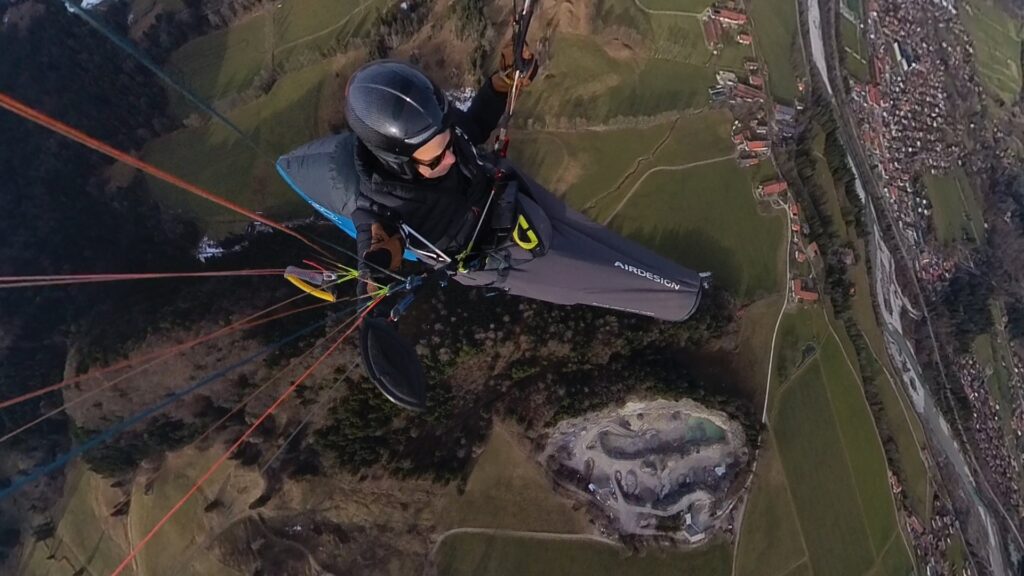
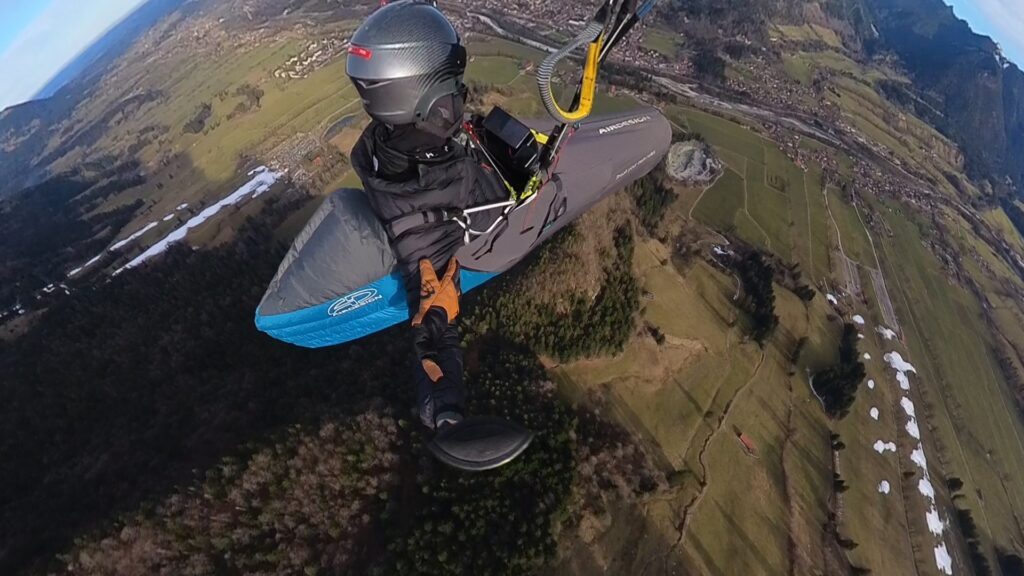
Due to the high suspension, the harness is relatively stable in the air. However, due to the calm winter air, I cannot say how the harness will behave in turbulent thermals. The tail bag should be packed carefully. Objects (buckles etc.) can cause discomfort in the back due to the thin fabric in the back area above the protector. The leg bag closes properly, I did not feel any draughts.
After opening the tube of the protector, the air escapes very quickly without having to press hard. The harness practically collapses on its own, without much effort, so that it can be packed away quickly. The pump bag also serves as a pack sack.
Experience
A pilot who has been flying the harness for a long time reported the following: “I can’t see any quality problems after about 30 flying hours. Everything looks neatly stitched. I don’t like the clamp fastener on the airbag hose so much, but it is also available from other harness manufacturers. You have to make sure that you get the tightest setting, otherwise the air will escape. I think the attachment and closing of the harness with the matching colours is well done. I also find the leg loops comfortable and didn’t miss the seat board.”
Conclusion
Positive:
- Large protector that also partially covers the back.
- Perfect fit for a lightweight harness.
- Plenty of storage space for bivouac flying.
- High seating comfort for a lightweight harness.
- Carabiner for the main suspension.
- Parachute connection line in the shoulder area, resulting in a standing landing after rescuer descent.
- Very simple fastening system for putting on the harness.
Negative:
- Little storage space available in flight.
- No seat board, cornering by using my body was not possible for me.
- Only the centre stage of the accelerator is stiff.
- Carabiner spacing not adjustable.
All in all, a very good harness that is very comfortable, especially for a lightweight harness. Whether it really is an all-rounder, as advertised on the homepage, is something everyone has to decide for themselves.
Would you like to see tests like this more often on my blog? I try to keep the cost of testing the harnesses low, but I would still appreciate a small donation from you as a token of your appreciation. You can find out how to donate here. Thank you very much.

Not mentioned: The main carabiners connect 3 attchment lines (upper part, chest strap & Speedbag). In case of a failure these 3 loops are NOT connected with each other. In my opinion a safety concern which can be solved by adding a redundant soft link.
This is a good point, thanks for the hint.